
The Ibovespa rose on Friday morning, December 19, boosted by advances in blue-chip companies and evidence of foreign capital inflows, despite lingering budgetary worries.
The benchmark Brazilian stock index began at 157,928.31 points with no change, momentarily falling 0.01% to 157,906.06 points before gaining traction.
By 11 a.m., the index had risen 0.78% to 159,149.67 points. Investors are carefully following the decision on Brazil’s 2026 budget, according to local media outlet InfoMoney.
The Ibovespa’s gain is due in part to rising commodity prices and strong momentum in most US stock market indices.
The day coincided with the expiration of B3 stock options and a relatively light local and international economic calendar.
Dollar decline and interest rates influence market moves
The collapse of the US dollar and prospects for future interest rates influenced Ibovespa movements as well. The political situation in Brazil remained stable, offering extra support to the market.
In the United States, New York Fed President John Williams stated that, while interest rates are projected to decline ultimately, the Fed will wait to analyze economic performance before making any moves.
According to William Castro Alves, Chief Strategist at Avenue, the most significant dangers to markets and the global economy in 2026 are a probable Fed interest rate hike and an artificial intelligence (AI) bubble.
“No one is talking about interest rate increases in 2026, but if for some reason there is a shock or an inflationary surprise that leads to higher rates, it will change expectations,” Alves told Reuters.
He also mentioned that the actions of a hypothetical incoming Fed chairman could influence market dynamics.
Market Volatility and Election Uncertainty
After two straight days of falls, the Bovespa Index finished higher on Thursday and continued to rise on Friday. Analyst Matheus Spiess of Empiricus Research noted that electoral noise has influenced the index’s volatility.
Following an approximately 4% dip on December 5, the market rebounded before falling again.
Spiess predicted that this volatility would persist as the 2026 elections approached, with markets waiting for clarity on candidate names.
The 2026 budget vote and fiscal considerations
Markets remain focused on Brazil’s fiscal outlook, as the Joint Budget Committee (CMO) began voting on the Annual Budget Bill (PLOA) for 2026 at 10 a.m.
The proposed budget sets spending at R$6.543 trillion and aims for a surplus of R$34.5 billion, which is somewhat higher than the fiscal target of R$34.3 billion.
If passed by the committee, the bill will proceed to the National Congress plenary.
Finance Minister Fernando Haddad called the idea “challenging but credible” and underlined that, while there is still work to be done, public finances have been disorganized since 2015.
Haddad is attending an event in São Paulo with President Luiz Inácio Lula da Silva on Friday.
Global factors and commodities support gains
Internationally, the Bank of Japan increased interest rates from 0.50% to 0.75%, the highest level in 30 years.
The market also reacted to external sector statistics, which showed a current account deficit of US$4.943 billion in November, somewhat less than the median projection of US$5.05 billion.
Foreign Direct Investment (FDI) totaled $9.820 billion, which was on the high end of projections.
Commodity prices helped drive the Ibovespa’s advances, with oil up roughly 0.60% and iron ore closing 0.52% higher in Dalian.
Vale (VALE3) rose 0.16%, Petrobras (PETR3; PETR4) rose 0.39% and 0.12%, respectively, while the majority of large bank stocks advanced by around 1%, with the exception of BB (BBAS3), which declined 0.32%.
Outlook for 2026
Despite recent currency weakness, equities analyst Matheus Amaral at Inter believes the Ibovespa has room for further gains in 2026, aided by the probability of a Selic rate decrease early next year.
He also mentioned that predictions of US interest rate cuts and stretched valuations in US technology companies could shift capital to emerging economies such as Brazil.
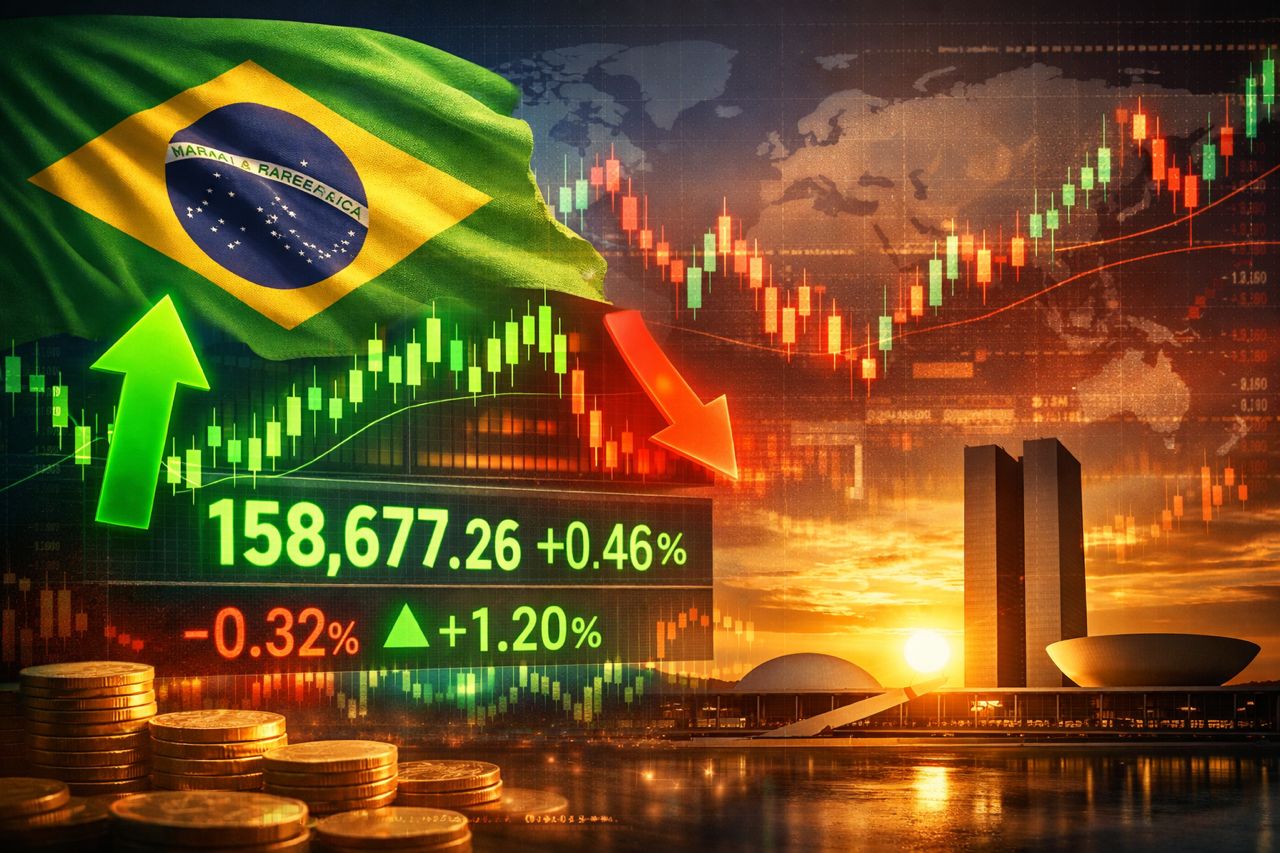
The Ibovespa was up 0.46% at 158,677.26 points as of 11:22 a.m., demonstrating sustained investor optimism in the face of local fiscal measures and favorable global market circumstances.
The post Brazil’s Ibovespa gains on Blue-Chip strength amid budget vote, global cues appeared first on Invezz
